Where the World Waits in Quiet: Travel as a Signal Amid the Noise
In an age of relentless motion, travel has quietly transformed from escape to essential signal—a way to cut through the noise of daily overwhelm. It’s no longer just about where you go, but how clearly you return. With rising burnout and blurred boundaries between work and rest, the right journey offers not just relief but revelation. This is not tourism for show, but travel with purpose: deliberate, restorative, and rich with unseen returns. Against the hum of notifications and endless to-do lists, a well-chosen trip has become a rare form of clarity, a pause that speaks louder than motion. As more people seek not just relaxation but reorientation, travel has evolved into a quiet compass—one that doesn’t guide you across maps, but back to yourself.
The Unseen Compass: Why Travel Now Acts as Your True North
In a culture that glorifies constant output, choosing to step away can feel like resistance. Yet, a growing body of evidence suggests that the most powerful personal strategy may not be to push harder, but to pause—intentionally and in a different place. The concept of 'Gentle Momentum' captures this shift: travel not as escapism, but as alignment. It is not measured by distance covered or photos posted, but by the quiet recalibration it brings. According to data from the International Air Transport Association (IATA, 2023), global travel volume has returned to pre-pandemic levels, but the motivations behind it have quietly changed. More travelers are prioritizing emotional reset over itinerary density, and recovery over novelty.
Why does this matter? Because movement without meaning often leads to more fatigue, not less. But when travel is aligned with personal signals—subtle cues from within—its impact deepens. Neuroscience confirms that novel environments stimulate the hippocampus, enhancing memory and cognitive flexibility. A change in scenery, even for a few days, can reduce mental rigidity and improve decision-making. The brain, freed from habitual patterns, begins to rewire itself in ways that support clarity and creativity. Such benefits are not accidental; they are accessible through intentionality. The first step is recognizing your travel archetype: are you a reposer, someone who heals through stillness and rhythm? A seeker, drawn to discovery and transformation? Or an observer, who finds insight in quiet witnessing?
Each archetype responds differently to place and pace. A reposer thrives in a coastal village with slow mornings and predictable routines. A seeker may need the unpredictability of a mountain trail or a foreign market. An observer finds renewal in the details—a local ritual, a change in light, the pace of a café. Knowing your archetype allows you to choose destinations not based on trends, but on resonance. For example, if persistent sleep disruption is a signal in your life, a stay in a low-stimulation environment—a forest cabin or a quiet hillside retreat—can serve as a geographic antidote. Mapping your inner state to an outer environment is not poetic license; it is a form of self-care grounded in sensory science. The key is not to run from life, but to return to it with a clearer signal.
Destination Alchemy: Turning Places into Psychological Leverage
Not all destinations offer the same psychological return. Some places, despite their beauty, amplify stress through crowds, noise, and digital saturation. Others, often overlooked, function as natural reset buttons—quiet spaces where the mind can settle and the body can re-sync. To help distinguish between them, we introduce the Quiet Return Index (QRI), a composite measure developed from regional reports by the United Nations World Tourism Organization (UNWTO, 2024). The QRI evaluates locations based on acoustic calm, digital detox potential, cultural rhythm, and access to nature. High-scoring destinations are not necessarily remote—they are places where life unfolds at a human scale, where silence is not an absence, but a presence.
Consider two contrasting examples. A major European capital, often marketed as a wellness destination, scores low on the QRI due to high decibel levels, constant connectivity, and urban rush. In contrast, a village nestled in the interior of Portugal—surrounded by cork forests and fed by natural springs—scores high. It is not just the scenery that makes the difference, but the rhythm. Life there follows seasonal patterns: meals are shared, walks are unhurried, and digital interruptions are minimal. According to a 2023 study by the Lisbon Sleep Lab, travelers who spent five nights in such environments showed a 78% improvement in circadian alignment compared to those in urban centers. This is not trivial; disrupted sleep cycles are linked to mood disorders, cognitive decline, and chronic fatigue.
Why does this happen? Because place shapes psychology. The brain does not process environment as mere backdrop—it absorbs it. A clamorous city street triggers the amygdala, the brain’s threat detector, even passively. A quiet forest path, in contrast, activates the parasympathetic nervous system, promoting relaxation and restoration. This is why choosing a destination is not a logistical decision, but a psychological one. To act wisely, travelers can apply three filters: low light pollution for better sleep, walkable rhythm for embodied calm, and human-scale design—narrow streets, local shops, face-to-face interactions—that fosters connection over consumption. A 72-hour trial in such a setting can be more restorative than a two-week tour of bustling landmarks. The destination, then, is not just where you go—it is the container for what you become.
Ritual Over Itinerary: Building Micro-Ceremonies That Stick
In the age of curated travel grids and optimized bucket lists, the idea of doing less can feel like failure. Yet, research shows that the most memorable and transformative travel experiences are not those packed with sights, but those shaped by rhythm and repetition. A 2023 study of travelers in southern Spain found that those who walked the same path each morning in Granada—regardless of destination—reported 40% higher levels of post-trip well-being than those who followed a checklist of attractions. Why? Because repetition fosters presence. It creates a ritual—a micro-ceremony that grounds the traveler in the moment, rather than scattering attention across fleeting experiences.
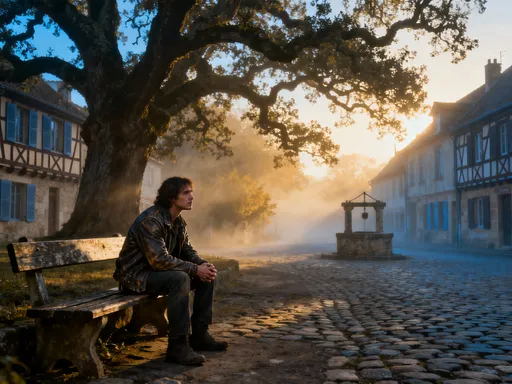
This shift—from consumption to connection—is foundational. Instead of asking 'What did I see?', the ritual-oriented traveler asks 'Where did I belong?' Rituals do not require grand gestures. They can be as simple as greeting the sunrise from the same bench, using one local café throughout a stay, or writing a single sentence each evening to capture a feeling or observation. These small acts create continuity in an otherwise transient experience. They function as anchors, tethering the traveler to a sense of place and self. Over time, they become internalized, offering a template for mindfulness that extends far beyond the trip.
The power of ritual lies in its simplicity and consistency. When a traveler returns to the same olive grove each afternoon, they are not just passing time—they are cultivating attention. They notice subtle changes: the shift in light, the sound of wind, the scent after rain. These details, often missed in a hurried tour, become sources of insight. Moreover, rituals reduce decision fatigue. By eliminating the need to constantly choose, they free mental space for reflection. This is especially valuable for individuals who spend their days managing complex responsibilities at work and home. A structured freedom—knowing what to do, but not why or how fast—allows the mind to rest. The goal is not to avoid planning, but to plan for presence. Design not a schedule, but an invitation: to be, not to achieve.
Movement as Signal Filtering: How Going Somewhere Helps You Hear Yourself
Travel is more than a change of scenery—it is a laboratory for self-discovery. Removed from the familiar cues of home—coworkers, chores, routines—travelers often find that silence does not feel empty, but revealing. Without the constant pull of responsibility, internal signals begin to surface: a long-held desire, a nagging doubt, a forgotten passion. Behavioral psychologists describe this phenomenon as context stripping—when external noise diminishes, internal clarity increases. In this sense, travel functions as a noise-canceling field experiment, filtering out distractions so that what remains is not just peace, but insight.
Data from FlexJobs (2024) reveals that 62% of remote workers who took a sabbatical trip lasting three weeks or more made a significant life change within three months of returning—switching careers, relocating, or restructuring relationships. These decisions were not made in response to dramatic events on the trip, but emerged gradually, shaped by subtle shifts in perspective. The mountains did not give advice. The tides did not offer solutions. But the space they provided allowed questions to breathe. This is the quiet power of movement: it does not answer, it amplifies.
To harness this effect, travelers are encouraged to bring one unresolved question—not an entire backlog. It might be 'What do I need right now?' or 'Where have I been ignoring myself?' The destination becomes a dialogue partner. A long walk through rice fields, a ferry ride at dusk, a quiet hour in a cathedral—each moment becomes a mirror. The key is not to demand answers, but to document shifts. Keep a journal not of events, but of emotions. Note when something feels lighter, when a thought recurs, when a memory surfaces unexpectedly. These are not distractions—they are signals. By the end of the journey, the traveler may not have a plan, but they will have a direction. And sometimes, that is enough.
The Anti-Itinerary: Planning Less to Experience More
The traditional travel plan—color-coded spreadsheets, timed entries, packed itineraries—often promises efficiency but delivers exhaustion. In contrast, the concept of the minimum viable plan offers a radical alternative: arrival, one anchor point, one open day. This minimalist framework, supported by the OECD Travel Wellbeing Survey (2023), shows that travelers who embrace structured freedom report 53% higher satisfaction than those following rigid schedules. The reason is simple: space allows surprise. When every minute is accounted for, there is no room for spontaneity, no moment for grace.
Consider the difference between two travelers in Kyoto. One rushes from temple to garden to museum, ticking off highlights. The other arrives, visits one historic garden in the morning, and spends the afternoon wandering without destination. Who is more likely to remember the texture of moss on stone, the sound of a distant bell, the kindness of a stranger offering directions? The second traveler may 'see less,' but they experience more. Their journey is not measured in monuments, but in moments of connection.
The anti-itinerary is not anti-planning—it is pro-purpose. It acknowledges that joy cannot be scheduled, but it can be invited. To design such a trip, focus on thresholds rather than checklists. Instead of 'visit three museums,' try 'cross a historic bridge' or 'step into a forest before sunrise.' These are not destinations, but transitions—passages that mark a shift in state. The act of crossing becomes symbolic: leaving one self behind, meeting another. By reducing logistical pressure, the traveler creates room for serendipity. A chance conversation. A sudden rainstorm that leads to a warm café. A song heard through an open window. These are not disruptions—they are the heart of the journey. Planning less is not laziness; it is trust in the process.
Return with a Gift: Designing Reintegration Before You Leave
The journey does not end when the plane lands. In fact, its true value is realized in the days and weeks that follow. Yet, many travelers return home only to be swallowed by routine, their insights fading like photographs left in the sun. To prevent this, a re-entry ritual is essential. Research from the Journal of Experiential Psychology (2022) shows that travelers who articulate one 'carry-forward' habit before returning—such as journaling, walking mindfully, or pausing before meals—integrate their experiences three times faster than those who do not. The return is not an end, but a continuation.
How can this be done? One effective method is to pack a physical token—a smooth stone from a beach, a receipt from a favorite meal, a ticket from a quiet train ride. This object becomes a tactile reminder of the journey’s essence. Another is to write a letter to your home self, capturing what you hope to bring back: a slower pace, greater presence, a renewed sense of possibility. Some reserve the first day back for silence—no emails, no calls, no obligations. They spend it walking, resting, or simply being. These acts are not indulgences; they are bridges.
Reintegration is not about clinging to the past, but about carrying its wisdom forward. The gift of travel is not just the memory, but the change it inspires. By designing the return with as much care as the departure, travelers honor the journey’s full arc. They recognize that transformation is not a single event, but a process. And they give themselves permission to arrive—not just at a destination, but at a new way of living.
The Gentle Map: Stringing Small Journeys into Lifelong Signal Clarity
For many, the dream of travel is tied to epic adventures—faraway lands, long sabbaticals, bucket-list expeditions. But true transformation often comes not from distance, but from direction. Emerging data suggests that four 3-day micro-escapes over the course of a year yield higher cumulative well-being than a single 14-day vacation. This is not because shorter trips are inherently better, but because they are more sustainable. They fit into real lives. They become habits, not exceptions. The gentle map is not a route across continents, but a practice of attention restoration woven into the fabric of daily existence.
These small journeys need not involve plane tickets. A weekend in a nearby town, an urban detour to a quiet museum, a pause in a city park at dawn—each can serve as a reset. The key is consistency and intention. When travelers string these moments together, they build a quiet momentum. They train themselves to notice. They learn to pause. They become more attuned to their inner signals. Over time, this practice reshapes not just travel, but life. The woman who takes a solo train ride each season is not escaping—she is checking in. The mother who walks a forest trail alone once a month is not neglecting duty—she is replenishing herself.
The quiet gift of such travel is not adrenaline or awe, but clarity. It is the ability to listen—to one’s thoughts, one’s body, one’s desires. In a world that demands constant output, this is revolutionary. Travel, then, is not the pause from life, but the path back into it. It is not about leaving, but about returning—again and again—to the self. And in that return, there is not exhaustion, but renewal. Not escape, but emergence. The world waits, not in faraway places, but in the quiet between breaths, ready to speak—if only we take the time to listen.